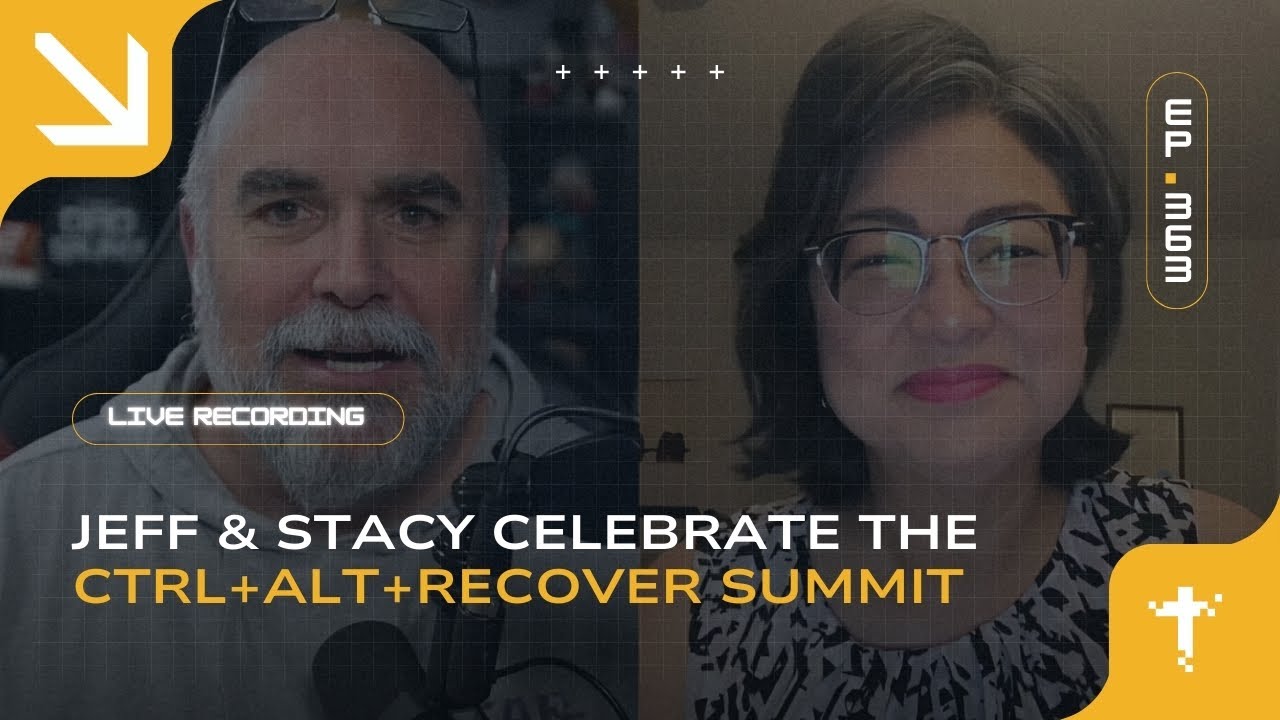
In this episode, Jeff Reed reflects on the CTRL+ALT+Recover Digital Missionary Summit and the powerful moments that unfolded. From unexpected tech challenges to raw, honest testimonies, the event high…
Jeff Reed and Stacy, TCD's Director of Care, debrief the CTRL+ALT+Recover Digital Missionary Summit — a Christ-centered recovery conference that launched with surprise tech failures and ended with unexpected breakthroughs. From Sepi's raw testimony of brokenness-to-restoration to Conrad Cooper's (Project Exodus) data-driven case that the church owns a hidden addiction crisis, this episode makes the case that digital missionaries can't shine light in dark spaces without first letting that light shine on themselves.
Jeff Reed: all right hey everybody welcome to the church digital podcast uh i you know oh my gosh i don't even know what i can never keep track of is this episode 373 363 999 i literally cannot remember what number i am except what the calendar tells me 362 this is episode 362 uh we're coming up on a full year of podcast episodes right around the corner god bless you if you could listen to me one hour a day for a full year i don't know that you would be any smarter But that may be a conversation for a different day. All right. Hey, listen, today, this episode, we are celebrating Control-Alt-Recover, our second Digital Missionary Summit that we did here in the fall. We're excited about what's happening. We've got Europe coming up next week. But right here today, I want to bring on Stacey. Hey, Stacey. Hey. How are you doing? Good.
Stacy Knapp: Great. Thank you. Thank you.
Jeff Reed: Stacey is our director of care, a chaplain for the Church Digital, and really just played a crucial role in putting together the Control Alt Recover, our digital Christ-centered recovery conference that we hosted yesterday. And so we've got Conrad Cooper's session. They'll be coming up here in a little bit, but I wanted to take a minute or two, maybe celebrate some wins, get some initial opinions on the conference and thoughts and recollections from yesterday. And so, Stacey, first off, welcome back to the show. Thank you so much. Great to be here. Always love our conversations. Good. Totally. 100%. And if you're watching currently live in the audience, we're going to ignore you because we are doing this prerecorded 100%. Psych! It's on you. No, in all seriousness, I've never done. I don't like doing this, but scheduling just didn't, it did not work anywhere. And I really wanted Stacey to be a part of this. And so I literally rolled out of bed, threw on a shirt and was like, okay, let's actually do the recording. Which considering I'm East Coast and Stacey's, you know, ODARC 30 where she's at. Thank you, Stacey, for coming on this show and being with us.
Stacy Knapp: So good to do this.
Jeff Reed: So Stacey. Tell us, like, initial thoughts, opinions. Like, what did you think of the conference yesterday?
Stacy Knapp: It went well. I would say there was, I think... minds blown you know some people are saying how much that it impacted them on seppi's story of transformation um and i think what really was compelling was her honesty and and transparency and um which for those of us who are ministering anywhere in a digital space or anywhere else, it's hard. It's a challenge to be that transparent and honest. I mean, who can you talk to? You're not going to talk to the people you serve. I mean, you want to be honest, but not with the deep, hard, traumatic things that have happened in your life. But we do need that. And so that's what I'm really excited about us, TCD, providing that space, care, a culture of recovery. And so, yeah, that that was a big, big, I think, moment for a number of people like in the chat. We're saying, yeah, honestly, we need this. We need this transparency.
Jeff Reed: sepi's story was um it was we it was funny we weren't planning on opening the conference with with that story we had some technical issues the internet broke on us uh literal internet broke on us in that situation um i just had to to adapt and so we we moved steppy's story early And just an incredible story of brokenness. And then, you know, it maybe sounds like cliche, but like the restoration after the brokenness and how God is using her and amplified her. through that restoration. The brokenness was not the end of the journey. The brokenness was really the beginning of her journey and how God rebuilt her, restored her, and then amplified her ministry after the fact.
Stacy Knapp: Amplified is a good word. Amplified is a good word. You know, she shared with me how she's just seeing in her obedience to the Lord that she knows she needs to share her story. She didn't know what that was going to look like, but here she is on a global scale. You know, she was I think she mentioned she was working or, yeah, with focus on the family in Africa. And then it went there. Her story was shared there. And then and then here we are on TCD Global, you know, and I was getting feedback from some people from TCD that are in Southern California. And just even at the very end, I got a message. of uh at the end of seppi's testimony someone sent me a message to say how compelling it was and she's so thankful that she attended you know at least just to hear seppi's story now that really set a tone though right it sets it set a tone though it was not planned for her to go first but that set a tone for the rest of the conference to say no this is what we're this is This is not just another story. This is going to be part of our story, for TCD's story, of our culture and what we're going to nurture within TCD.
Jeff Reed: Yeah. Brokenness, vulnerability, transparency. First off, biblically, and I actually have done some look into this, God never breaks things and rebuilds it exactly the same way. Biblically, we never see that story. We see where things are broken, and then they're rebuilt in a different way to be utilized better. By God. And so to be broken in some of these situations, like Seppi and Seppi's story, and even in my restoration story of being broken and being remolded, being reshaped, being refiner's fire, burning out the impurities. These things are crucial. To be used by God in physical space, yes, but even digitally. And oh, by the way, being vulnerable in digital environment makes you so much more endearing as digital missionaries. It makes you so much more. more open, which allows for heartfelt conversations. I understand the pain that you're feeling. I understand this because I've struggled with it too. There's such a connection point relationally to be able to engage with people as digital missionaries, understanding this and being able to deal with that. Have you experienced anything like that or know of people who have? Absolutely.
Stacy Knapp: oh yeah absolutely i i um gosh my first 12 steps experience i think was 2009 maybe maybe 2011 that that time and uh i didn't know i didn't know what it was about it's just that someone at the church um said oh we have we have a recovery ministry here and what was really a really powerful moment for me was that the pastor, senior pastor, lead pastor would join us, but he wouldn't join us for the group, you know, because he's, but he joined us for the meal that we'd have before our group. And he'd talk about CR and, and, um, the, the, you know, with CR celebrate recovery, but the, the, uh, for him though, at that time, there wasn't a 12 steps community for leaders, senior leaders. And so, um, um, but the fact that he wanted to be so connected with us, even though he couldn't join us, that, that said something like I took, took note of that. I observed that. And I thought, Hmm, when a leader, senior leader wants to be transparent and open and honest, um, that, that was, yeah, that was, uh, um, a big observation for me and said, okay, I think I need to check this out, you know? And And then, um, yes. And I, my eyes were so open. I got even the going through the 12 steps the first time around that was just scratching the surface. Right. And, um, I discovered my, my identity was found in how much I served and how much I needed to, or, or kind of, um, making like a tally, you know, of opportunities of when i served so i never said no i did not know the word no i said yes to whatever anyone said hey sure okay why not yeah i yeah and that time was single and have kids you know i didn't don't have kids so i um i believed that it's just distorted thinking that because i'm i don't have those responsibilities that um then i i i have to say yes It was, you know, it's putting my need to serve in affirmation in the place of God himself. Like that was my affection, right? My affection was... not just saying yes, but people happy that I said yes.
Jeff Reed: Yeah. Man, replacing God itself. We're going in some heady topics really, really quickly. Yeah.
Stacy Knapp: Well, you know, and, and that's, that was the beginning of my journey where I stayed that those are two different things serving and then my affection for Jesus, two different things. And, um, it's out of overflow, right? We serve, but also I didn't know the word, you know, I didn't know about being responsible for, uh, my time, my energy, uh, being a good steward, um, of my body, all those things. I just didn't understand until I started the recovery journey. Um, yeah, it, it's, I, I'd say I worshiped, um, I worshiped the act of service. And, you know, there's all the underlying issues, you know, of why that is, why that happened, why that was such a just a really deep part of me that I thought I was supposed to be good. I believed I believe the church culture was about just serving.
Jeff Reed: and it's it's not it's a bite in me like jesus says in me then you'll bear much fruit but i was just the appearance of perception of bearing fruit is what i was doing that's that's interesting yeah there was a was one of the best lines from the conference um yesterday for me uh was conrad cooper we're going to show his section here in in a little bit but when he said, you know, the church, you know, itself has a recovery problem. It's not individuals, it's the, you know, the big C church maybe here in 2025. And actually, it was funny, I actually saw, you know, he talked about how six of seven pastors had either a current issue with pornography or a previous issue of pornography. And it was funny, like, you know, that's 83% of pastors, if my math is correct. And in my lifetime, a guy that spent 30 plus years working closely with pastors, I can barely think of five pastors in my life who have even had a conversation or I've heard say the word pornography. Like, it is literally the church's best kept secret, unfortunately, in this situation. And it was actually, it was in my life. I saw this yesterday. Conrad was on stage and I was off stage. And I got a text from a couple of pastors I'm working with currently. And one of them texted, hey, you know, at a physical church, pastor at a physical church here in Miami. And a couple of them texted, you're just checking in how the conference is going. And in a kind of quipped back via text, oh, just some South African guy on stage right now talking about porn addiction. And literally, one of the pastors is like, wow, you don't hear that every day? And it's just because it's like it's been the, you're not allowed to talk about it. You're not allowed to recognize it. And as a church culture, like I shared yesterday in my own life, where early on in my ministry career, I was told, hey, if you're struggling with addictive behaviors, quit your job and leave the church because we don't want you to mess up what God is doing here. And while that... That's an unfortunate reality that many pastors are under. That's really a struggle of where the church is. Maybe the church does need to have a session of recovery, a season to recover from some of these bad ideologies. There was a Barnastat that just came out. 65-75% of pastors think about quitting every year. Well, with the pressure and the onus of perfection and not actually allowed to be human and not having anyone around them that they can trust to have hard conversations like this, is there any wonder they're thinking about quitting at such a high level every year? It's amazing to me how much the church has kind of painted itself into a corner, not ready to embrace some of these realities of today.
Stacy Knapp: And heaven forbid that we actually rest as ministers, that we actually honor Sabbath. Yeah. I mean, we're not good at that.
Jeff Reed: Yeah, I actually, I had a, no, it's true. A good friend of mine, a pastor at a church, he had earned a sabbatical, which was, I think in his context, six to eight weeks off. And he worked an additional three years before he took that sabbatical time. Because according to him, there was never a good time to take it. Honest to God, true story, right hand up. He had not told his wife he had earned the sabbatical. That was an issue. That he had earned the sabbatical and his wife had no idea. And when crap came out, it was a difficult season. But I mean, that's just somewhat, that's this, that's like the wool over the, what's the saying there? It's like the, you're being blinded to it. Hey, you know, I'm doing everything I can for God. I'm working for the penultimate reason. Everything for the kingdom, everything short of sin. Like we've even said that here on the stream, you know, let's go. You know, it's better to burn out than rust out. You know, some of that ideology. But what happens as a result of that is, you know, you experience it. We heard about this from Laura Howe yesterday in the conference. A lot of that compassion fatigue, burnout, exhaustion. You know, shoot, I had a conference yesterday and I'm exhausted and I've got bronchitis. I'm coughing up phlegm and like my body just took a toll on one day. Sorry for that. That was gross. but to be able to to do this over like years and years and just being beat down um and yes jesus is there and and we have that that connection but sometimes a physical connection or we need people around us to speak the truth of jesus in our lives but we don't we don't trust the people around us enough to be vulnerable to share with them what's really going on in our lives yeah when we talk about nurturing that culture
Stacy Knapp: You know, it does. It starts from the top. It starts with us as ministers. And then, and I think that's, and it's not about pointing the finger at the church, right? Growing up, that's what it was. You know, I'm thinking about 80s. the eighties and nineties, how we're, cause we're it it's output. It's, it's getting things out there. It's, uh, but it's not, but we keep things hidden, hidden, but pain, the pain, the sorrow, uh, the trauma we've experienced, you know, um, you know, we're, we're, we have not nurtured that environment to the transparency and care and talk through things. And, um, Hey, let's let, let's have a,
Jeff Reed: care groups but hey if you need to seek out a therapist counselor you know by all means let's let's get you let's get help when when i put together the conference and when we put together the conference the speakers like it for me it was i thought we would be talking more about creating a culture of recovery and how to address it at an organizational level what and even like some of the questions of the people that were talking and coming in it was it was not um it really wasn't as much culture as much as it was individuals like that was kind of that was a huh i didn't anticipate that Where it was not like how to get your organization in recovery. It's, hey, I'm struggling with this. One of the questions yesterday was, at what point is it an addiction versus just a regular sin or like just a mistake? Like, at what point, how many times do you have to sin to have the sin become an addiction as opposed to, you know, not? And I was like, does it matter? Like, you know, even if it's once, you're addicted to something. Like, acknowledge that and say it and allow God to work through the acknowledgement of it. Stop trying to justify I'm not as bad as I think I am. It's really not that bad. It's just like I'm trying to think like it's so it's just in this moment, you know, David's up up on the on the roof with Bathsheba. Oh, I can look. I can look once. I just like it needs to be a really long look. I can't look. Oh, I look the second time. OK. All right. No, a third time. That's where it's oh, I should reach out. No, no, no, no. It's like you got a problem and it's OK to have a problem. By admitting you have the problem, you work through the problem. Sorry.
Stacy Knapp: Right. Yeah. No, that's how it's no, but it was, but that's what it is. It's like, well, you got to ask if you have to ask, you know, it's like, you know. It's okay. That's the thing I wanted to say to that person. Like, good for you though. I mean, like, you know, here you are asking the question, at least that, you know, while the, while here, some of us are just holding it inside and we'll hold it for years till the day we die, you know? So, or, or it's, it implodes, right? It implodes.
Jeff Reed: yeah it's for those that that have the courage to rebuild without crashing like you know there was a graphic we shared maybe it's time to reboot without the crash like if you cannot have your if you can correct the issue without self-destructing that's that's a that's a that's a great place to be have the courage to acknowledge some of these things in your life bring the people around you You know, I lived in fear of I didn't want the people around me to know this. Well, when the crash came, the people around me found out and much better. It's much better to deal with it in in like, hey, I have the courage. I have the strength to manage this on my own. Through God, we're going to tackle this together rather than saying, my life is now over. I am totally at rock bottom here. So have the strength to do some of that. At least that would be my prayer and encouragement for you. But what all this told us at the individual level is that TCD, the path that we're on for care, for recovery, for, you know, even, you know, we've been talking about the word thriving, like creating a thriving digital missionary and helping provide training and coaching for that and peer-to-peer support and beyond. We're on the right path as we're trying to help people take these next steps in. Once again, I said yesterday in the conference, if we're going to shine the light in the digital darkness, we've got to be aware that that light's going to be shining on us and to be vulnerable and transparent to address where we are so that we can help others that are in a similar position. uh that is that's a place that that are the church digital missionaries that once connected with us they need to they need to see they need to represent they need to to know and so that would be my challenge for you uh out there watching this is is to maybe listen to some as we're transitioning over comrade cooper in a second he's doing his keynote talk um as we're recognizing some of the issues and struggles right now with the big, you know, big C church, the U.S. church, wherever. Conrad Cooper's in South Africa, so he's not even talking about the U.S. church. He's just talking about the church. As we're talking about the church in general today and some of the stigmas that they're wrestling with, you know, maybe there's a challenge for you at the individual level to start to recognize who can you influence for the kingdom And are you in a position where you can influence them? Or do you need to address some of the issues that you have in your life in such a way? Know that we, the Church Digital, we care for you. We want to be there for you. We are rolling out recovery program where our leadership's going through it right now in 25. We're going to start some betas in 26. Stacey's and her team are championing that. Thechurch.digital.com recovery. You can check out that webpage, thechurch.digital.com recovery, and that some more information is there on that. You know, Stacey, I know we got to cut this session short, but as we're wrapping up here on your side, any closing thoughts?
Stacy Knapp: Yeah, the invitation. The invitation is, and I totally wholeheartedly believe this is Jesus. Jesus' invitation to you is to consider, to consider the investment of time and effort doing the inner work in recovery so that we bear much fruit. This is part of, to me, abiding, abiding in him. that we will always put him first. Our affection to him solely is first, one and only, not the fruit. And so please consider this invitation to join us.
Jeff Reed: Beautiful. So with that, I'm going to hand it over to Conrad Cooper from the conference yesterday. Conrad Cooper is founder and executive director of Project Exodus, one of the organizations that we're partnering very closely with. And so we're going to open up with a three-minute video on Project Exodus, and then that'll transition into Conrad Cooper's talk. titled Recovery Rewired. So let me go hand it over to the video. And thanks, y'all. See you next time.
SPEAKER_01: Addiction and mental health challenges don't stop at destroying individual lives. Their effect spreads to families and whole communities. And yet most people suffer in silence. Nearly two-thirds of youth and young adults report watching pornography on a weekly basis. Over the past decade, global drug usage has surged by 23% and yet 90% of those who need help never receive it. Despite this grim reality, change is possible. Recovery is possible. But it requires support. No one should do it alone. The solution can be found in the church. With its reach, infrastructure and heart, the church is uniquely positioned to make a profound and lasting difference. As the body of Christ, we're called to take action. We've been commissioned to bring hope to the hopeless, healing to the broken, and freedom to the captives. But many churches and organizations can feel overwhelmed and ill-equipped, unsure where to start or how to sustain recovery efforts until now. Built on the foundation of God's word, Project Exodus is a non-profit recovery ministry empowering your church with effective and innovative recovery strategies. Our recovery tools are biblically based and life-giving, bringing real and lasting change. Through our web platform, Bridge, and our online academy, you'll gain access to all the resources, training, and support needed to lead lifesaving recovery groups and programs. Whether addressing addiction and supporter recovery, mental health recovery or pornography recovery, our solutions are accessible, scalable and sustainable, designed to meet people where they are and guide them forward. If you have the heart to help, our step-by-step process will empower you. Previous experience is not required. Simply sign up, get certified and launch your group. This isn't just theory. Decades of experience inform our evidence-based strategies, empowering churches to build cultures of recovery that transform homes, neighborhoods, and entire communities. You see, the need is urgent, and the solution starts with you. With the right tools and support, you can take action and make a difference. Together, we can grow a culture of recovery, one person, one church, and one community at a time.
SPEAKER_02: Hi, guys. Good day all from South Africa. Good evening to you. From our perspective here, it's now sitting at 1830 p.m. I'm speaking from a small town down in the south coast called George. And our team is also based in Durban and around the country as well as in some places internationally. But first, I just want to give you greetings from South Africa. No, it's not as bad as it's made out to be in the States. and absolutely amazing and beautiful countryside. And we are determined to embrace change and to do the things that need to be done to seize the kingdom. So yeah, just a shout out to Jeff and Church Digital. Amazing to work with you guys. We spent some good time together, not nearly enough. At times we wish to be in person just so one can give you a good hug and a pat on the back for the work and the initiatives that you're grabbing onto. So well done. Thank you for the honor and privilege of being here. So yeah, I'm excited to move along. So, excuse me, by God's grace, I've been in recovery 25 and a half years going on 26 years. And, um, yeah, it's, it's, uh, it's been a journey indeed has been a journey. It started off on the 2nd of January, 2000, after many years caught up in addiction and we've all got our war stories and, uh, there's no need to reiterate what those are. And, uh, I think for each of us, um, it's our, it's our own cross and our own process in each one that carries. the pain carries it without comparison to another. But yeah, my journey ended up in Hillbrow and getting shot and eventually sitting in a crack house in a rather dangerous part of Johannesburg on the 2nd of January, 2000. And I woke up desperate, just like I couldn't anymore. I'd been trying for years to get this thing right in and out of rehab and really just couldn't manage to get myself out. And yeah, I cried out to God and ended up in an amazing church, Ramah Church. That's a Sunday morning, 2nd of January, 2000. I gave my life to the Lord and ended up going straight back to the dodgiest part of Johannesburg that you can ever think of. However, for the next 18 days, he just slammed doors shut and blocked my way. And I found myself checking into a really hardcore Christian rehabilitation center. I thought, well, that we get too easily, we esteem too lightly. So I picked the hard way to get things done. And God did what he does best. He just moved and shifted my life around. And the journey of restoration and the journey of healing started that day that I left there. And as I left the treatment center, I will never forget that there was a picture of the sun coming up from behind the mountain, not actually a picture, the real thing. And God spoke to me clearly and he said, I'm needing to open a rehabilitation center. And I debated with him, like, who is this speaking to me? I had no experience with that. at that point in time and uh yeah i've been in the motor industry and done a while at that time but had no experience in recovery yet at that stage So I ended up a short while later being obedient and opening up a treatment center that went on to become a flagship treatment center in South Africa and internationally, which I ran with some amazing people and family for 18 years. And we really changed the way we wanted to do recovery and the way that we believe recovery should be done. You know, he shouted out like, you know, who can I send? And when we put our hands up to say, here I am, it's quite hard to pull them back down. But more importantly, he also goes on to say, behold, I'm doing a new thing. Can you not feel it? Can you not see it? Can you not perceive it? And I see that's what's happening here today on Control-Alt-Delete to see this church digital recovery initiative really taking ground and really seizing the territory. So yeah, South Coast went on to become an amazing facility that really taught us how to do things in a different manner. It really brought home a situation that I really wanted to draw attention to, that's 2 Corinthians 12.7. When it says that in our weakness His strength is perfected, it really goes on further to say that the power and authority of the grace of the Creator of the universe rests upon us. I mean, in our week, his strength is perfected. And I just felt really strongly today that we are very definitely those that are called to more and called into that space of really getting the work done. Not just being mere spectators, but really understanding that there's a whole lot of work that needs to be done and best that we do it ourselves with immediacy. Cool. So today we're going to be speaking about dismantling unhelpful narratives. I'm trying to challenge the outdated strategies as he laid out my heart some 20 years ago, 25 years ago, that we're needing to do a new thing and create a new way that the success rate that we're being demonstrated in treatment centers internationally, not only in South Africa, but you know, from systems that had been developed many, many years ago that really we needed to push into the word and to create something fresh and new and absolutely, you know, deliberate to what he's doing. So with that process, we are also looking just how the church can change and understand that actually addiction is out there, not in here. So when we say that it's not in here, sorry, just one second, if I may, please. Sorry, my feed just jumped there in a second. Understanding addiction is not out there. It's right in here. It's with us. It's online with us. Being online in itself is a really present process that we all experience. to the point of asking ourselves that, you know, should we take our devices or our connectivity away? What kind of withdrawal symptoms would we experience? Have you a need of digital detox? So really asking those hard core questions that in fact, one in every four people are battling depression. And I think those are conservatives, sorry, one in every six people. I think those are conservative numbers. I don't feel that that is accurate. We know certainly in South Africa that the collective trauma is way greater than that. and that addiction is related to all of these kind of processes. So, yeah, I do feel that when we look at it and we're starting to understand that it goes further than substance abuse and further than alcohol, that in fact 79% of men and 76% of women watch pornography regularly. Obviously, that's a particular sector. as a lot of us are familiar with, is that really the situation that we're facing is really challenging. With that amount of people being able to be stuck into pornography, it's quite horrifying. I think probably one of the more challenging ones is in terms of the pastors and the church. And as we sit in that space and we try to think of, you know, with pastors and with the church, digital and otherwise, is there a safe space? Is there a space to go for leaders in the church, youth leaders, youth pastors, worship leaders, executive pastors, pastors' wives? And in that kind of space, we really feel that the work that we've been able to be exposed to is significant. There's a desperate need. Sorry, excuse me, a desperate need of how do we provide help? Is it anonymous? And we'll touch on that a little bit later. Is it best to bring it out onto the platform? Is it best to be able to create a testimony out of it? How do we actually work in a space that is going to protect the church? When we talk about pastors and leadership, and I know there's many out there on the platform today, it's a really important kind of process of what we're needing to wrestle with, how we bring it into the open. and understanding that the pornography is one area and one aspect of it. But the reality is that it's everywhere. It's in the church, it's in the people that we sit next to, it's in the people that we work with. And it's certainly, very definitely in the church. I've got a great friend of mine, Derek, he's quite a hooligan, and he's like, This is the leprosy that the current church, the nowadays church is facing inside of the church. And if we don't take ownership and take development in that, we are really going to get ourselves caught into a process that is not helpful at all. Talking about processes, we also need to understand the process addiction, that myth that it's not so bad. A little bit of porn never hurt anybody. We work online, so why should that become a problem? But if we really dig it deep, and I'm sure all of you are also familiar with this, and if not, I would encourage you to really dive into researching data and see what the trends are. because we want to go upstream. We don't want to be the guys that are trying to catch people in the dam at the bottom, but to really go upstream and be part of the solution. And we understand that those kind of symptoms are very similar. When we are talking about coming off of a heroin addiction, or if we are coming off of fentanyl, or if we're coming off of a pharmaceutical, or a sex addiction or working out the relationship between a sex addiction and a marriage and working in the space of eating disorders and how to manage that. The symptoms are all crossing over and the biological effects are also very, very, very closely tied into it. The neurological impact we know and understand now is one that can be restored, but it takes time. And we do need to create those neurological pathways and to be able to foster healthy, workable neurological pathways whilst also taking a change within the ability to understand the underlying principles. In fact, If you, I'm sure you've seen this one. I've said that a couple of times today, but this particular slide really just stands out for me. We use it a lot in our training and when we go into the churches and we've trained them to several thousand churches so far in our career in Project Exodus of changing the way that recovery is being delivered. And we see that the normal brain on the left hand side looks healthy. We've been driving through an amazing part of the country over the last two days and it often looks like they're brown and barren, but yet there's green and shrubs and growth. But if you look at a heroin user and we compare that to somebody that's using pornography, the damage is significant and the similarities are also significant. The challenge that the church and our environment faces that often when addiction is the discussion or we are working with people that are coming out of addiction or fighting to find their way into freedom and remembering that freedom is not just a one-off kind of position. I know for me personally that the healing and the immediate kind of miracle that took place with me besides my salvation is that my ability to have a freedom of choice was restored. So my freedom of choice was restored. It remains my responsibility to maintain that freedom. But the families go... Yeah, the families get impacted significantly and we have to ask ourselves, are we doing enough for the families? Are the families being given a voice? Are they going along their own recovery journey? Are they getting the ability to understand what has happened to them? What's the kind of trauma that sits within that kind of space? Because 71% of spouses experience post-traumatic stress disorder symptoms. In fact, The intimate partner violence and the regular pornography use is just an escalating pandemic. The divorce rates are more than double, I believe. And it is actually critical that we address recovery from a holistic perspective, not just from the guys that are in recovery or battling to get into recovery or using. And the truth of the matter is that the process addiction is often more than just the same. and just as damaging, but far, far greater. Often we hear the guy saying, well, I can't afford to go to rehab, or if I get to rehab, that's going to solve the problem. And when my loved one or employee or our church member gets back or our leadership gets back, then the rehab's done the job. And we know that these days that is simply not the case. In fact, 90% of people who need treatment never receive it. We are fortunate in South Africa that we have an ability to really try and reach far and wide through a national drug master plan. But the resources to be able to deliver that is really, really stretched. And unfortunately, we know on an international level, according to the World Health Organization and the UNODC, is that treatment challenges remain significant. Affordability is a significant process around it. Availability to developmental resolution by center program is limited. Often treatment rehabs are, um, The time that we've spent investing in our recovery in this worship disorder that we've aligned lives against, careers against, families, businesses, and ministries against, that one month or two months or three months is insufficient in terms of duration and has debatable efficacy. What is the particular challenge is that the continuum of care that needs to be maintained in treatment is often flawed. And that break in communication, the break in the continuity of treatment means that short-term treatment simply lacks efficacy in its sustainability. So from our perspective, if we look at time within recovery, there's that old saying, I'm sure everybody knows that time takes time. We have an amazing fruit here in South Africa called the popo, which takes time to get ripe. And if you grab this beautiful succulent fruit and you try and squeeze it ripe, we know that it doesn't feature into a way of any kind of duration. So that 28 days is not going to do very much in terms of assisting in the transition of stopping and perhaps getting a level of stabilization. Long-term treatment takes time, and the healing and the restoration is a critical component that goes with that. We found it really helpful in working with the churches and to be able to spread a good understanding of what addiction is and perhaps even what it's not, but more importantly what it is, just to really be able to understand it from an iceberg principle. It shows a lot of... clarity in terms of folk who are not understanding what the addiction criteria are and who debate it and who wonder from a medical perspective whether that is covering it well. But we do know the symptoms of what it looks like with isolation, denial, trauma, dual diagnosis, deregulation, shame, culture, spiritual, of course, spiritual disconnection, emotional intelligence, et cetera. It really makes a significant impact if they have an understanding of especially from a church perspective, that there's a complex and a substantial bound of work that needs to be done in that ongoing development and restoration as far as the East is from the West. And in fact, when we look at recovery, we see truth, community, mental health being restored, new mindsets, healthy beliefs, self-worth, spiritual connection, authenticity, optimal brain functioning, relationships being restored, coping skills being established, and so on, and we really see the fruits of a culture of recovery. And the reality sits and remains that the truth is that effective strategies and accessible access need to be ongoing. It's not a one-off thing. It's not a quick fix. It's a process. As we do the paradigm shift as far as the East is from the West, we are pushing off of a point and driving towards the East. And in that space, we're pushing away. We're needing to build momentum, build culture, build sustainability. And we understand critically that in the next myth that the church is not a hospital and it's not able to do the things that need to be done, actually, there's a whole lot that the church can do that hasn't been done, I should add. The church has a pivotal role to play. to provide continuum of care, to provide support, non-judgment, to understand that it's not them and us. Critically, people coming into recovery within the church actually is the whole church because we are in a state of recovery. We are being restored to our rightful potential and position in Christ. And we know that that process of sanctification carries on the whole time. It's just different levels. And in fact, when we work with the guys who are seeking recovery and healing and restoration, be it from trauma and post-traumatic stress and... um and substance abuse and the families being affected etc we are all on the same journey of seeking christ and ready to push into it and the church is perfectly positioned perfectly positioned to take a stand so we know that scripture well we know the scripture well and he does he does destroy So from our perspective as Project Xers, we love to empower the local church. And the joy of digital is that the local church stretches far and wide. And we really want to change the culture of addiction, of negativity, of by works into a situation that actually there's work to be done in faith and to be able to work together in partnership and in the ability to create a recovery culture through recovery services in a broader community base. And the question remains that If the church doesn't do this, who will? I think within the States, the war on drugs has been ongoing in many ways, in terms of walls, in terms of budgets, in terms of, you know, it's all over the world, you know, the bridges that have been broken down of trying to get this right. And really the answer remains in the church. And if the church doesn't, who will? Many churches host a meeting, and they want just a meeting to be great. We've got a meeting, guys, and I can see you're a bit under the weather. At church today, you're coming to pray for people, but perhaps spending a little bit of alcohol. Let's send them to a meeting that's been hosted in the church. That's not going to work from my perspective. We've got to break down the walls between them and us. We have to do that. The church needs to own the ministry as part of the church. And when I say own the ministry, the congregation, the community, the leadership needs to start speaking about this and talking about it and really running and establishing a culture, a whirlpool of recovery within the church. Because we are looking for a church that is not inward looking, but outward looking. And that's where discipleship and restoration takes place. My favorite scripture, we love to do this in training, it's a little bit difficult to do online, but this scripture of leaving the 99 in the wide open country and going after the one. And we, at the moment, are in sheep country. And let me tell you, there's thorn bushes and dry ground and snakes and everything else that goes with it. But when you leave the 99 and go after the one, it's not an easy process. It's not a quick fix. It's about going out and getting dirty, getting your hands dirty, and really, really making a difference within that space. So remembering that leading a dynamic recovery ministry is the church's mandate. It's not about the champion in the church or the guy who's got a vested interest in this. It's not about that. Because the moment we take the iceberg principle, we know that only 10% is the actual addiction behavior, and then 90% is what sustains it. And anybody who's been through a death or grieving or post-traumatic stress or any of these multiple processes still have that 90% of hurt and shame or grief or processing or loss or any of these areas to work with. And that is the church. It's not them and us. If we don't create this whirlpool deliberately and create that momentum, break the inertia and maintain that momentum, we are going to carry on losing the pathway. There's this subject about anonymity is critical. I have a tattoo, which I'm not meant to be showing around, but I thought, why not do it? Seeing as it's online, but Ezekiel 37. belly of the bones. We are raising up an army and it's not going to help if the guys are being quiet and ducking back to be in or not in sin or to be able to create a lack of accountability. Accountability is the church. Authenticity is the church. Truth is the church. Speaking it out, bringing it out into the light. That's the church. So whilst we can respect that process of bringing people into the courage and ability of developing a testimony because we know we're overcome by the power of the blood of the lamb and the word of our spoken testimony, that it is really, really, really critical. Sin dies in the light. It is a critical component. That when I'm weak, then I'm strong. It's when I'm weak, his strength, in fact, is perfected in my weakness. Not my strength. his strength. And who wouldn't want that? Not that I'm encouraging to go and become addicted so that you can experience that. No, quite the contrary. It's about you don't have to be an addiction to be involved in the recovery of the church. We need to shift this from shame into glory to be able to really bring to light spaces where nothing needs to be hidden. Groups are a cutting edge process to be able to do that. and to build community, and to build this process. So I tonight want to just really say to you that life is better in a circle. We are born that way. I'm not sure how much time is left, and I would encourage you to jump onto our website and really find out much about our approach. Our approach is innovative. It is Christ-centered. It is new. It is cutting edge. It's piloted. It is beautiful, and we would encourage you to really partake in life-giving, resolution-orientated Jeff, I think you guys are amazing. And we look forward to a way forward in the future. And really, let's raise up an army and get the work done that needs to be done.
Jeff Reed: Thanks so much. I love this. Conrad, don't go anywhere. Stay on. Such a good presentation. I was talking offline with Andy and Stacey backstage. And just like this is your brain. This is your brain on this. whatever the drug was, and this is your brain on porn. Like that was, that was no pun intended, mind blowing for me to see, you know, what the effect of that is. The idea of the recovery of the church where, you know, okay, you may or may not be addicted to something, but we all can have a part playing in the recovery of the church and embracing the stigmas Six of seven pastors have struggled with porn at some time in their lives. And I just did a mental check. And I can think of five that I've had a conversation with in my lifetime. And I'm a guy that's worked with pastors the majority of my career life. around that and so yeah you know there's there's a lot of stigmas that that that are surrounded by this now now we're i want to ask a couple questions we're a bunch of you know um you know the ragamuffin band uh square pegs and round holes island of toys yeah you know we're close to that and very much so and you know we're the people who think differently so you know as a as an organization as as an end at the individual levels really want to go yes um what what does how do we how do we change like normally how do we enact change normally it's like top down okay let's get a you know a lead pastor's got to get a vision and do something and then there's like organization change That's really not who we are. We're individuals kind of at the bottom of this. And so how would you suggest, what does it look like to maybe start to enact that change or create that cultural shift within organizations?
SPEAKER_02: Sure, sure. Jeff, I think, you know, and not to be cliched and say like prayer is a good solution to it because it's, you know, obviously, but, you know, we all have to pray for more wisdom and faith. So I think it's a good decision to be able to educate ourselves as much as we possibly can in that area. We were up in Zambia a short while ago working with a whole bunch of bishops in those areas representing multiple churches. And we were chatting to them and doing a presentation. And they said, your stats are great, Conrad. But let me tell you ours is that every week we see five bodies of people that have killed themselves from suicide, from shame of pornography or homosexuality or those kind of spaces and substance abuse overdoses. And that's in Lusaka. And when you look at that and you start looking at the amount of children that have gone through sexual abuse and the numbers are just staggering, absolutely staggering. It comes down to one person making a change or making a difference. And it's about really embracing that process and saying, I'm going to be making a difference and making a change. Start the conversations. Be authentic. Be transparent. If you're struggling or you're going through a... Don't hide. Don't give it the power. In fact, disempower it by bringing into the light with some strong folks. You can speak to us. We can direct you. Create safe spaces initially to get this going and to build the momentum. There's great training online. You can jump onto the online training. We'll teach you how to run groups. And I know a lot of us, we run small groups and those kind of things. But when you have a good technique and good structure, And then you have a depth of resource that is available to you, which you can deliver within the group culture and the whirlpool. Very quickly, we can create action. And many churches start like that through small home groups. So, yeah, get it started. Get into it. Take a stand.
Jeff Reed: Prophesy. I love this. I was going to ask a question about culture and how to establish the culture. But we actually just had a question come in in the Q&A that I think is good. What are signs that we are inventing a porn addiction instead of just every once in a while falling for porn? Like, at what point is it the person saying, I would not call it addiction, just a bad thing? Like, at what point does it become, oh, I failed, you know, once to, oh, yeah. I got a problem.
SPEAKER_02: Yeah. Yeah. Brilliant question. Thanks for your courage of coming out and doing that. The answer to your question is I think you've answered the question. The reality is in our minds, both from a biblical perspective and from an addiction perspective, is if we move this word addiction and we demystify the word addiction, it's from a Latin word meaning wholly devoted to. Yeah. Yeah. So if we take the picture of needles and death and everything else out of the way, and we look at a behavior disorder, and we look that we do not want to keep on crucifying Christ or going back into living in sin, we want to bring it into a place behind it. There's some hectic quotes. Looking at pornography is as if heroin has been devised 100 times stronger than heroin injected directly into our eyes. When that image comes into your mind and into your process behind it, it's really difficult to remove. It alters the way that we think. It alters our spiritual foundation and our spiritual base. In fact, Jesus, you're sure, was so strong in it. He said, if you lust with your eyes, you've committed adultery already within that space. Not to give you a heavy or to lay a trip on it, but if you're assessing it, like, why would you want to do it? Why would you want to look at the daughter of our king being abused on a screen? Why would you want to be able to look at your daughter, perhaps? We have to start asking ourselves some really seriously hard questions that, is that in God's will or my will? And if we are really going to be reverent and pushing into a place of reverence, there's an amazing book by John Bevere. Maybe for some guys, it's not for everybody. Maybe, don't know. But for me, the reverence of our king is something that changes lives. So if you're going to do it and you do it once, that's once too much. It is probably the most addictive behavior. Having run treatment centers, and we've had big treatment centers and running it for long-term treatment, pornography is perhaps one of the hardest behavior disorders. It's the word addiction and discard that. That behavior disorder is so duplicitous. and stealthy and so close to the truth in terms of sex and in terms of love and creation and marriage and all of those kind of things why would we want to endanger ourselves and our godly purpose and our wives and our husbands and because the women are like a couple of percent down that road so yeah if you're asking the question you need to go challenge yourself
Jeff Reed: Yeah, so good. It's just even to follow up on this at a personal level. And thank you, the person that's asking the question. Yeah, yeah. It's like for at a personal level for me, I fought for years whether or not I was addicted in that that years of me asking that question actually prevented me from from getting the help that I need. And it wasn't until I said, OK, I don't even know what it means, but OK, I'm addicted. You know, I stopped the fight. where the brokenness of that actually, I believe, allowed God to kind of work through me in that. It's not a problem.
SPEAKER_02: It's not a problem.
Jeff Reed: You know, Romans 3, as pastors, we talk about it all the time. You know, for all of sin and all in short, we're not getting there. And so as a result of that, you know, what is addiction? Is it one time? Is it two times? Is it three times? 10, 20? Does it matter? You know, at the greater point of this, asking that question honestly became a defense mechanism preventing me from getting the help that I needed.
SPEAKER_02: Jeff, can I jump just one comment onto the back of what you're saying? When we start talking about breaking myths and breaking the process behind it, the introduction of the word addict as a qualifying process behind it is a complete misdirection. It's not about... I fit this label or I don't fit this label. You said it. We're square pegs in a round hole. We're not the guys that run within the same kind of process around it. Let's take that word addiction completely out, that whole thing of rock bottom completely out. Who do you want to be in Christ? How do you want to behave? How would you like your daughter to be treated? Let's ask ourselves some really hard questions. Take that word addiction out because that is a block. to the healing and restoration that waits inside for your weakness, for his strength to be affected, so that you carry the authority of the creator of the universe on your shoulders. Game changer. Why would we want to do it?
Jeff Reed: Yeah, so good. All right, Project Exodus. If you're in Hublot, the link's on the website. If not, it's projectexodus.net is the website. Exodus.net. We, the Church Digital, are partnering with Project Exodus to create, once again, Project Exodus works with churches and organizations to create a culture of recovery. And we're happy to announce that we're going to get more into this here. in a little bit, that we are starting a recovery ministry and recovery groups and moving towards in that culture of recovery, working with Project Exodus, literally in South Africa. I'm excited. Stacey and the team has been working on this for a couple months now, getting certified and getting equipped and trained in all this. And so we're going to talk more about the beta in a little bit. But at an organizational level, if you're interested in creating A Culture of Recovery, projectexodus.net is a great option for you. Conrad, I know we've had some frustrating tech issues today.
SPEAKER_02: Yeah, no good problem.
Jeff Reed: And jumping on today, and I hope you have a good evening in South Africa. Yeah. And we'll be in touch soon, I'm sure.
SPEAKER_02: Wonderful. Thanks so much. God bless you. Thank you, sir. Bye.
Jeff Reed: all right hey uh one hour long stream and this is the third shirt i've been wearing this is jeff actually this time live live not not sim live from the conference or from my earlier conversation uh with stacy but i i'm excited uh coming off of the conference it was uh it was a It was a joyous headache. It was a technological nightmare. But we are so thankful for the people that came out to watch the conference, engage, ask questions. As I said with Stacey, it was a different audience than I was expecting. But I feel like God moved through it. And actually, a lot of the technological issues at a personal level, when the ISPs broke and 75% of the world's population could not access the content. the conference as we were starting said conference which is very discouraging globally um really just kind of got to the place where uh okay we've got to do this conference publicly and so we're gonna we're gonna i'm talking with leadership we gotta figure out a time to schedule it but i really i really am moved towards the fact that we need to uh rebroadcast the conference publicly, not in Hublot or not behind a login, but in a public environment for many to benefit from. And so if there's one takeaway to nightmare, technological nightmares, it's, you know, God speaks through the technological nightmares. God speaks through the difficulties. God speaks through others. God speaks through situations. You know, we could break down. Henry Blackaby's experiencing God all day long, but at the end of the day, God speaks when the internet crashes as well. And I am fully believing that God was speaking to me through yesterday's events. And maybe, just maybe he was speaking to you as well. And so if you enjoyed the conference, awesome. uh we've got europe coming up in five days and something hours uh it's wednesday very early 3 a.m eastern uh will be the start of the keynotes in europe 9 a.m cet i believe more information at missionary.digital slash europe www.missionary.digital europe find more information and register for the conference there almost 500 registered for that one we're excited you know what's interesting now you know what i'm going to save that one save that one for the next stream we're going to be giving a sneak peek on Tuesday for the Europe and so conference. So www.missionary.digital slash Europe, check out that page. And with that, we're going to wrap up today's stream for. We'll shoot for everybody that spoke at yesterday's conference. Thank you. I'm very thankful for our friends over at Project Exodus. Very thankful for our friends at Regeneration. Very thankful for our friends at Hope Made Strong. Like, there's just been so much. support for digital missionaries in the recovery in the christ-centered recovery space and i am very very much looking forward to what god has in store uh for our missionaries as we shine the light of uh christ in the dark and as a result of that have to be okay shining it on ourselves so For basically me on this stream, this is me. Thanks for jumping on the stream today. We'll see you next time on the show. Y'all have a good one.