Podcasting isn’t a trend. It’s a territory. And most churches haven’t claimed it yet.
Half of Americans are already listening to podcasts regularly. They’re doing it on their commute, at the gym, while cooking dinner. They’re inviting voices into the most intimate pockets of their day. The question isn’t whether your community is listening to podcasts — they are. The question is whether your church is one of the voices they’re hearing.
It should be.
Why Podcasting Works for Church Ministry
Unlike a Sunday sermon that requires physical presence, a podcast travels. It follows people into their week. It builds relationship through consistency and voice in a way that a social media graphic simply cannot.
Joe Radosevich joined us to unpack exactly how churches can leverage this medium — and the conversation surfaced some genuinely practical angles that most church leaders haven’t considered.
The big idea: podcasting isn’t just about broadcasting content. It’s about creating on-ramps for people who would never walk through your church doors first.
Four Ways Your Church Can Actually Use a Podcast
1. Extend your sermon content. Don’t just upload the Sunday message and call it a podcast. That’s a recording, not a show. Take your sermon series and build episodes around it — interviews with your pastor, Q&A episodes where you answer questions raised by the text, or conversations with people in your congregation whose stories connect to the theme. Give people a reason to listen before Sunday and after it.
2. Reach your neighborhood, not just your congregation. Your church exists in a specific geography. Use that. Interview local business owners, city officials, school principals, and community leaders. Cover issues your city cares about. Be a voice for your town. People searching for local content will find your podcast — and through it, find your church. This is digital missions at the street level.
3. Disciple your people throughout the week. Romans 10:17 says faith comes by hearing. A podcast gives you a discipleship channel that doesn’t require an event on the calendar. Launch a mid-week episode designed specifically for spiritual formation — a short devotional, a book discussion, a “faith and work” conversation. It keeps the church family connected between Sundays without adding another meeting to anyone’s schedule.
4. Train and equip your leaders. Got volunteers, small group leaders, or staff spread across multiple campuses or contexts? A private or unlisted podcast feed is an underutilized leadership development tool. Record your training content once, push it to a feed, and let your leaders consume it at their own pace.
Getting Started Without Overthinking It
Here’s what you actually need to launch:
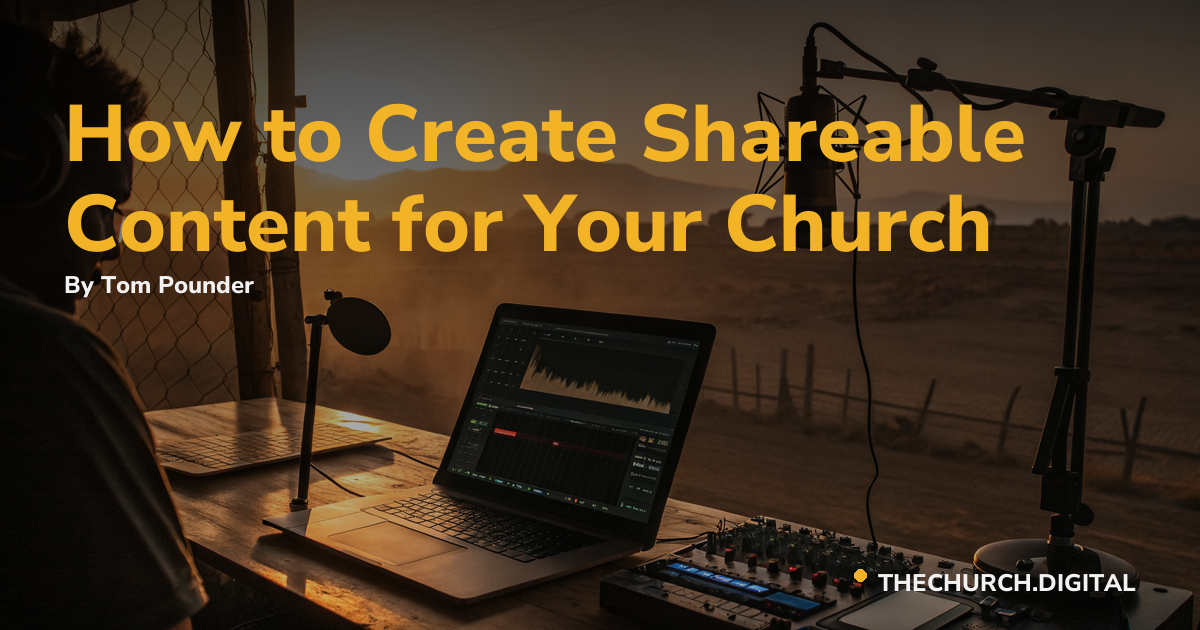
- A decent USB microphone. The Audio-Technica ATR2100x runs under $100 and sounds professional.
- Free hosting. Anchor (now Spotify for Podcasters) gets you distributed to Apple, Spotify, and Google at zero cost.
- A consistent format. Decide upfront: solo episodes, co-hosted, or interview-based. Consistency builds audience.
- A release schedule you can keep. Weekly is ideal. Bi-weekly is fine. Sporadic is a show killer.
Don’t wait until it’s perfect. The first ten episodes are practice. Ship them anyway.
The Evangelism Angle Nobody Talks About
Here’s what makes podcasting different from almost every other digital ministry tool: it’s searchable and it’s evergreen. A social media post disappears in hours. A podcast episode can be discovered two years from now by someone who has never heard of your church.
Someone going through a divorce searches “how to forgive my spouse.” Your episode on that topic surfaces. They listen for 40 minutes. They show up at your church the following Sunday. That’s not hypothetical — that’s how this works.
This is online evangelism in its most passive and powerful form. You create it once. It keeps working while you sleep.
Common Mistakes to Avoid
- Starting without a target listener in mind. Know who you’re talking to before you hit record.
- Making it purely internal. If every episode assumes the listener already attends your church, you’ve built a members-only club, not a ministry.
- Giving up after episode six. Most podcasts die before they find their audience. Commit to at least 20 episodes before you evaluate.
- Ignoring the description field. That’s where search happens. Write it like someone who doesn’t know your church will find it — because they will.
Your Next Step
Pick one of the four use cases above that fits your church’s current season. Just one. Then spend 30 minutes this week outlining what your first three episodes would cover.
Don’t build the whole show. Build the first three episodes. Then record them.
Your community is already listening to podcasts. Make sure some of what they’re hearing is you.
Want to go deeper? Join the Digital Bootcamp Facebook Group — a community of ministers learning to use digital tools effectively for real ministry. It’s free, it’s active, and it’ll sharpen your thinking fast.