Movement isn’t a program. It’s not a campaign. It’s not a viral moment that fades by Thursday.
Movement is what happens when ordinary people catch a vision so clear and a method so reproducible that they can’t not pass it on.
That’s the heartbeat behind theChurch.digital — and it’s worth unpacking why.
Why “Digital Church” Isn’t Enough
We didn’t start theChurch.digital just to help churches stream better or post prettier graphics. The vision was bigger and, honestly, more dangerous than that.
We wanted to see the gospel multiply in digital and metaverse spaces the same way it has multiplied in physical communities throughout history — organically, relationally, exponentially.
Digital church as a destination misses the point. Digital church as a launching pad for disciple-making movements? Now we’re talking.
The internet isn’t just a broadcast tower. It’s a mission field — arguably the largest, least-reached, most accessible mission field humanity has ever seen. Billions of people spend hours every day in digital spaces, many of them spiritually hungry and completely disconnected from any local church. The opportunity is staggering. The question is whether the Church will show up with programs or with presence.
Labels Matter Less Than the Process
In digital ministry, we throw around phrases like discipleship pathway, engagement funnel, digital community strategy. Fine. Use whatever label helps you think clearly.
But here’s what actually matters: Are you making disciples who make disciples?
That’s it. That’s the whole thing. Jesus didn’t say “go and build a great Sunday service.” He said go and make disciples — people who are so formed by the gospel and so equipped for mission that they turn around and do the same for someone else.
The labels don’t create movement. The process does. And the process has to be simple enough that a first-generation digital disciple can immediately begin doing it themselves.
The Five-Stage Movement System
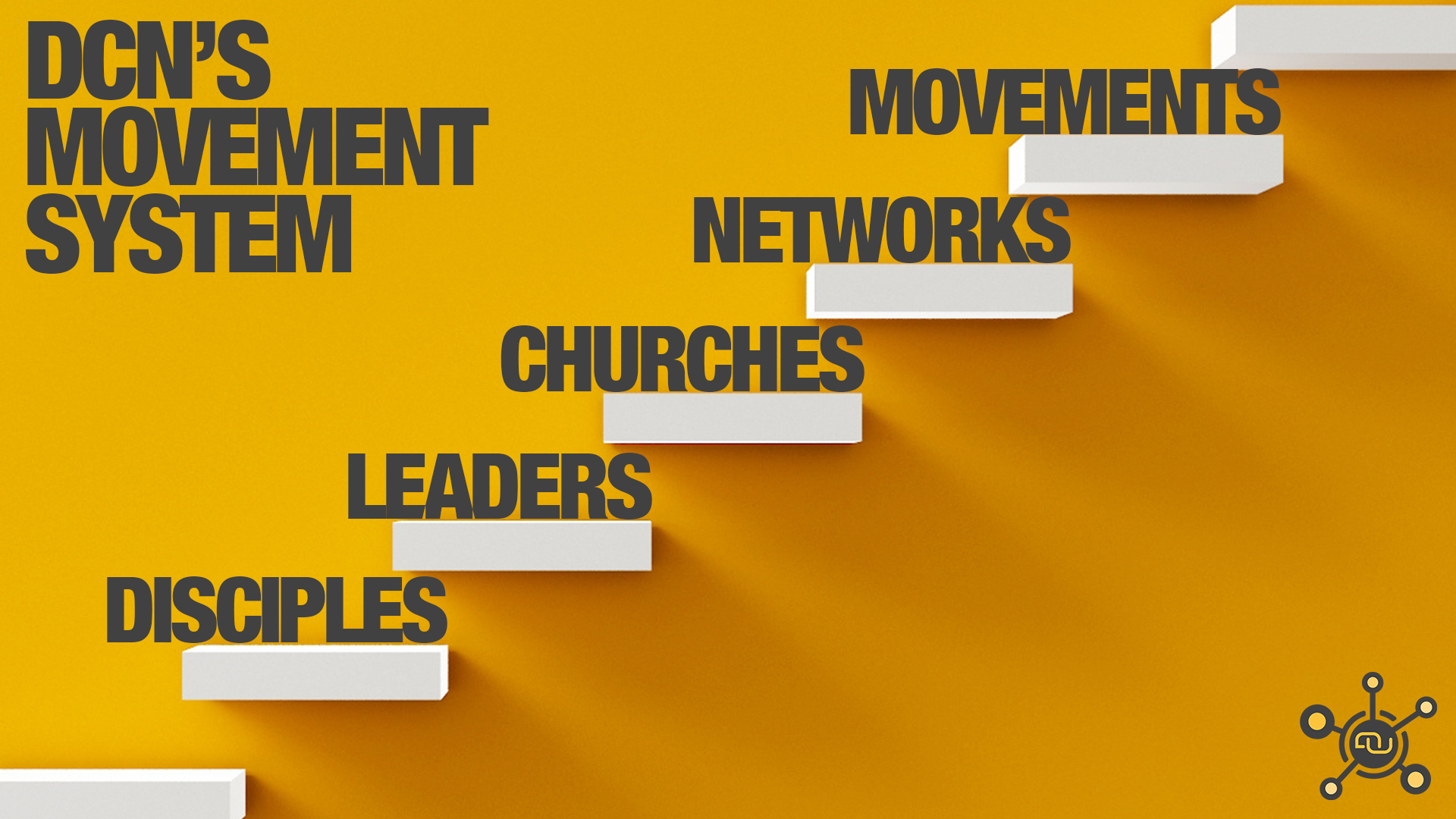
theChurch.digital’s Movement System is a framework for turning that process into something reproducible at scale. It’s not complicated. It’s actually the point:
1. Make Disciples — Start with one person. Meet them where they already are — a Discord server, a Facebook group, a gaming community, a subreddit. Build a real relationship. Open the Word. Walk with them.
2. Grow Leaders — Disciples don’t stay disciples forever. They grow. They develop gifts. They start leading others. Your job is to identify that growth early and lean into it, not hoard the ministry for yourself.
3. Plant Churches — Leaders don’t just lead small groups. They plant communities — contextually savvy, digitally native churches that belong to their space the way a neighborhood church belongs to its street.
4. Start Networks — Churches don’t live in isolation. They connect. They resource each other. They hold each other accountable. Networks create the relational infrastructure for something bigger than any single congregation.
5. Multiply Movements — Networks, when they’re healthy and outward-focused, become movements. And movements do what movements do: they reproduce the whole system again, in new spaces, with new people, reaching corners of the digital world nobody has touched yet.
Then steps 1–5 repeat. Constantly. That’s not a cycle — that’s a movement.
This Is for Ordinary People
Here’s what we need to be clear about: this isn’t just for professional church planters or seminary graduates. “[God] chose what is weak in the world to shame the strong” (1 Cor. 1:27). That’s not a consolation prize — that’s the strategy.
The gamer who leads a Bible study in their Discord server. The mom who starts a faith community inside a Facebook parenting group. The college student discipling peers through Instagram DMs. These are the movement-makers. They just need a framework, some training, and a community that believes in what they’re doing.
That’s exactly why we’re rolling out Learning Communities — quarterly cohorts designed to walk individuals and churches through the Movement System step by step. Not theory. Hands-on, contextual, practical equipping for real digital mission in real digital spaces.
What This Means for Your Ministry
If you lead a church, this isn’t a replacement for what you’re doing — it’s an amplifier. Imagine equipping your congregation to make disciples not just in your neighborhood, but across every digital community your people already inhabit.
If you’re a church planter, the digital mission field is wide open. You don’t need a building. You need a method and a community behind you.
Either way, the next step is the same.
Ready to stop watching movement happen somewhere else? Head to the Movement Systems page and see where you fit in — then check out our Learning Communities to get equipped and get moving.